
Key Takeaways
- With prediction markets heavily tilting toward a Democrat congressional win, the biggest investment surprise could come from the outcome investors least expect.
- History shows elections create headlines and volatility but rarely have a lasting impact on long-term market returns.
- Rather than trying to game political headlines or polling swings, investors achieve better outcomes through systematic, diversified portfolio allocation that removes emotional decision-making.
Politics Matters When Policy Matters
The United States heads to the polls on 3 November 2026. While the presidency is not on the ballot, control of both the House of Representatives and the Senate is at stake. The outcome will set the direction for tax legislation, industrial policy, clean energy incentives, defence commitments, and international trade over the next two years.
Not every election has significant consequences for financial markets. However, the 2026 mid-term elections arrive at a unique moment in the political cycle.
Following his victory in the 2024 presidential election, President Donald Trump returned to the White House with Republicans controlling both chambers of Congress. This political alignment has given the administration considerable freedom to pursue its legislative agenda, introducing policies that have attracted both strong support and intense criticism.
The political landscape can change quickly in a mid-term election. Even a modest shift in congressional control would substantially alter the legislative environment. A divided government would make it more difficult to pass major legislation and could introduce greater oversight of executive policies. Changes in committee leadership could also redirect priorities across infrastructure, defence, healthcare, clean energy and trade policy.
President Trump is well aware of what is at stake. Losing control of either chamber would significantly reduce the administration's ability to advance new initiatives during the final two years of his term.
To strengthen support ahead of the election, Trump has promoted several high-profile proposals, including a pledge to distribute a US$5,000 "Trump Dividend" payment to every adult American citizen if Republicans retain control of both the House and Senate. The administration has also attempted to rebuild relations with influential business figures and political allies, including Elon Musk, whose support was widely viewed as an important factor in Trump's 2024 electoral success.
As it stands today, Republicans maintain only a narrow advantage in Congress.
Party Breakdown of the US Congress
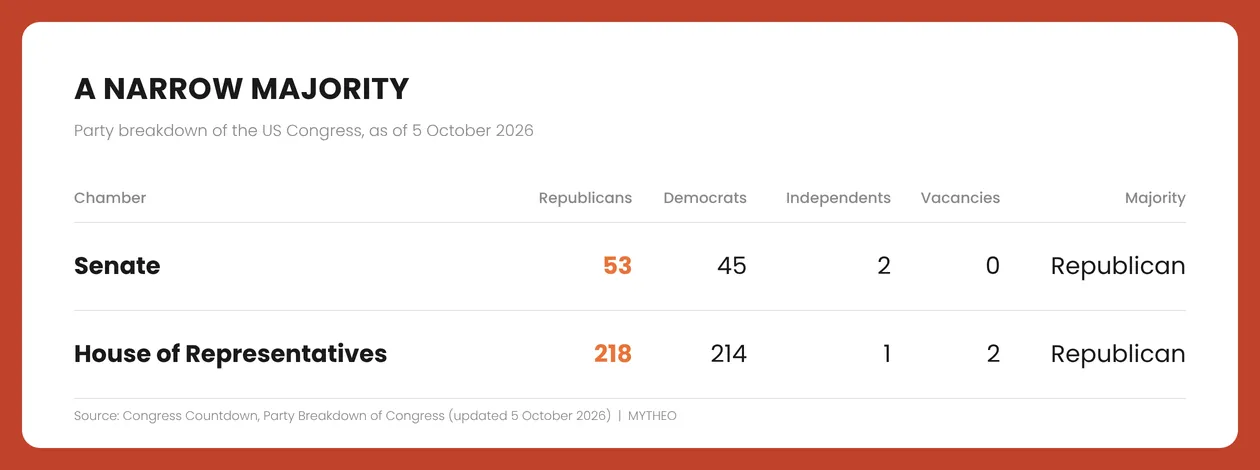
With relatively slim margins in both chambers, even small shifts in voter sentiment could have significant consequences for the balance of power in Washington.
Do Current Polls Point to a Major Shift in Washington?
Polling data and approval ratings highlight an increasingly demanding environment for President Trump and the Republican majority. Persistent cost of living pressures and geopolitical friction involving Iran have weighed on public sentiment.
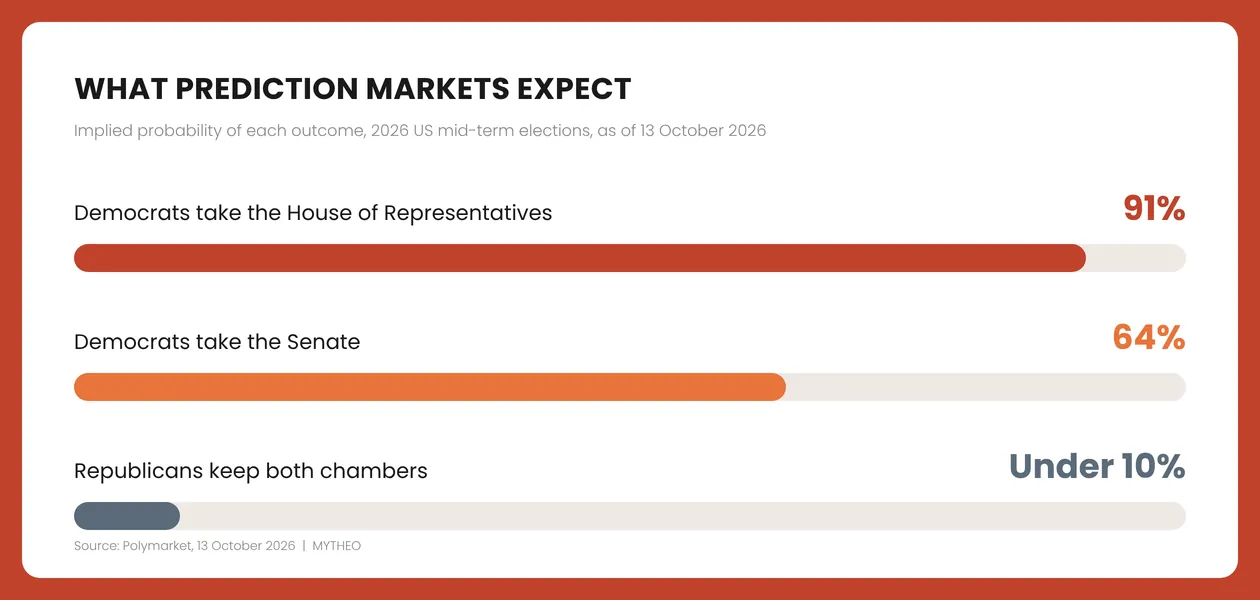
Prediction markets have also reflected this shift in sentiment. Polymarket, a blockchain-based forecasting platform where users trade on the outcomes of future events, currently assigns a high probability to Democrats regaining control of Congress.
As of 13 October 2026, the platform implies more than a 60% probability that Democrats will win both the House of Representatives and the Senate, with a 91% chance of Democrats taking the House of Representatives and a 64% chance of Democrats taking the Senate. The implied odds of Republicans retaining control of both the Senate and the House of Representatives have dropped below 10%.
Polymarket Prediction of the US Mid-term Election Result as of 13 October 2026
Potential Winners and Losers
As elections approach, investors naturally assess potential winners and losers. In our MYTHEO 2026 Outlook, we noted that markets could respond positively to a stronger Democrat showing. The rationale was simple: a divided government could temper some of the policy uncertainty and volatility linked to the Trump administration's more aggressive initiatives.
However, that possibility is no longer a surprise. As Democrat election prospects have steadily improved throughout the year, investors have increasingly incorporated those expectations into market pricing. If Democrats were to gain control of Congress, the market reaction may ultimately be more muted than many anticipate.
The bigger surprise may come from the opposite scenario. Should Republicans retain control of both the House and Senate, investors could be forced to reassess their current assumptions. Such an outcome may trigger sharper short-term market movements because it would challenge prevailing expectations rather than confirm them.
Even then, investors should be careful not to confuse short-term volatility with long-term investment outcomes.
Markets often react quickly to election headlines, reallocating capital towards sectors perceived as beneficiaries while punishing those viewed as potential losers. These initial reactions can be dramatic, but history suggests they rarely determine long-term investment outcomes.
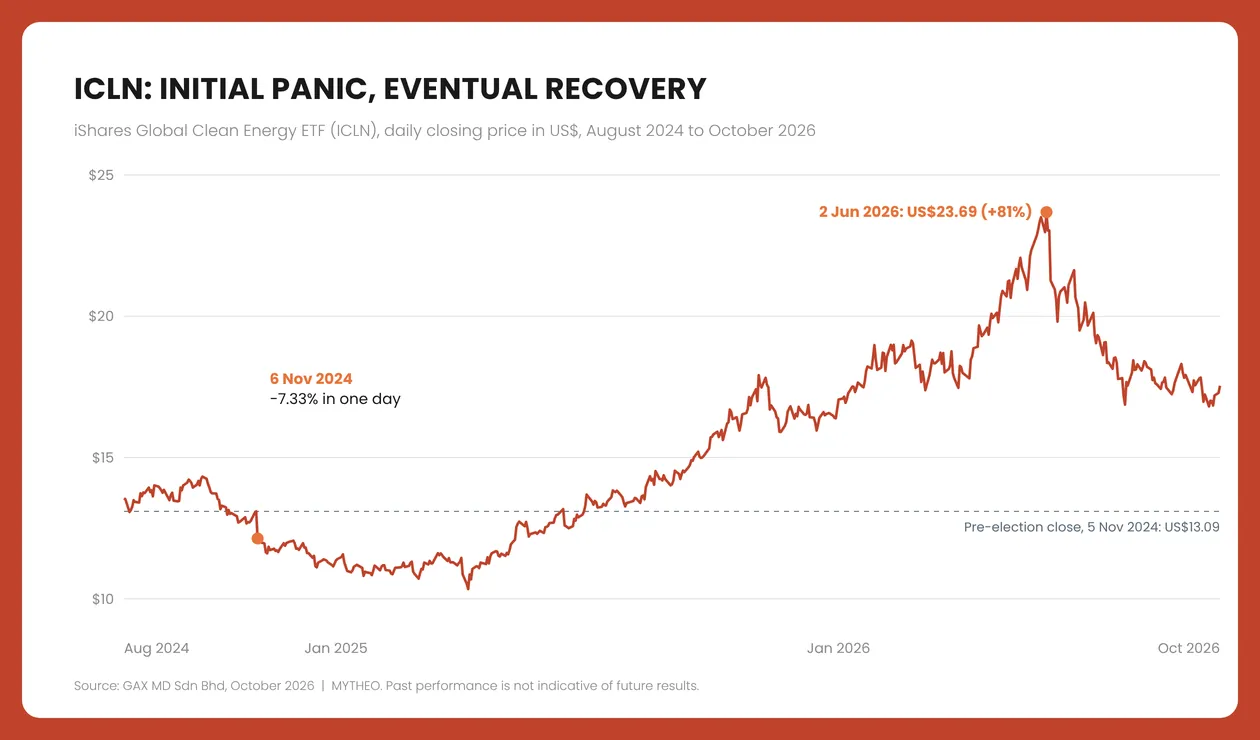
A useful example emerged following the 2024 US presidential election. When Donald Trump secured a second term in office, clean energy was widely viewed as one of the sectors most vulnerable to the incoming administration's policy agenda. Reflecting these concerns, the iShares Global Clean Energy ETF (ICLN) fell 7.33% on 6 November 2024, the day after the election result became clear.
However, the sell-off was short-lived. As investors shifted their focus back to industry fundamentals rather than political narratives, the sector gradually recovered. By 2 June 2026, ICLN had climbed to a multi-year high of US$23.69, about 81% above its pre-election level of US$13.09 before Trump's victory was confirmed.
The episode serves as a reminder that while elections can influence short-term sentiment and sector performance, the longer-term direction of markets is ultimately driven by factors such as earnings growth, valuations, technological innovation and economic fundamentals rather than political outcomes alone.
ICLN: Initial Panic, Eventual Recovery
The Bigger Question for Investors
The most important lesson from previous elections is that investors frequently fall into the trap of overestimating the lasting market impact of election outcomes. Politics drives short-term sentiment and sector rotation, but underlying cash flows, earnings power, productivity, and technological cycles determine long-term asset valuations. Politics may influence the journey, but it seldom changes the destination.
This is why investors should resist the temptation to make major portfolio decisions based solely on election predictions. Attempting to trade every political headline often introduces more risk than reward.
The 2026 US mid-term election will almost certainly generate volatility. Headlines will dominate news cycles, analysts will debate potential policy changes and markets may experience brief periods of uncertainty. Yet history suggests that the election itself is unlikely to be the defining factor behind long-term investment success.
Rather than reacting to daily campaign rhetoric, most investors achieve better outcomes through disciplined portfolio construction. By relying on an objective, systematically rebalancing framework rather than emotional speculation, investors position themselves to weather temporary volatility and capture long-term capital growth regardless of the balance of power in Washington.
That is precisely where MYTHEO's investment approach can add value. By relying on a systematic, algorithm-driven process rather than human emotion, MYTHEO is designed to navigate periods of uncertainty objectively, helping investors remain focused on what matters most: achieving their long-term financial goals regardless of who ultimately wins the election.
Ready to explore how MYTHEO works for your goals? Learn more here.
Or download our app so you can start investing in a moment. Download on iOS here or Android here.
To register for MYTHEO, you can get started here.
This material is subject to MYTHEO’s Notice and Disclaimer.