
Key Takeaways
- Oil surged on fears of a prolonged Iran conflict, only to reverse weeks later as negotiations resumed. The report explains why investors who react emotionally to geopolitical headlines often underperform those who focus on long-term fundamentals
- One of the world's strongest stock markets suddenly became one of its worst performers, triggering millions of margin calls and forced liquidations. The report examines how leverage and concentrated bets can quickly turn market optimism into financial stress.
- Microsoft and Amazon erased June's losses after strong earnings, but not every AI-related company may benefit equally going forward. The report explores why the next phase of the AI boom could create both winners and losers across the technology ecosystem
Market Review:
*Source: GAX MD Sdn Bhd, August 2026
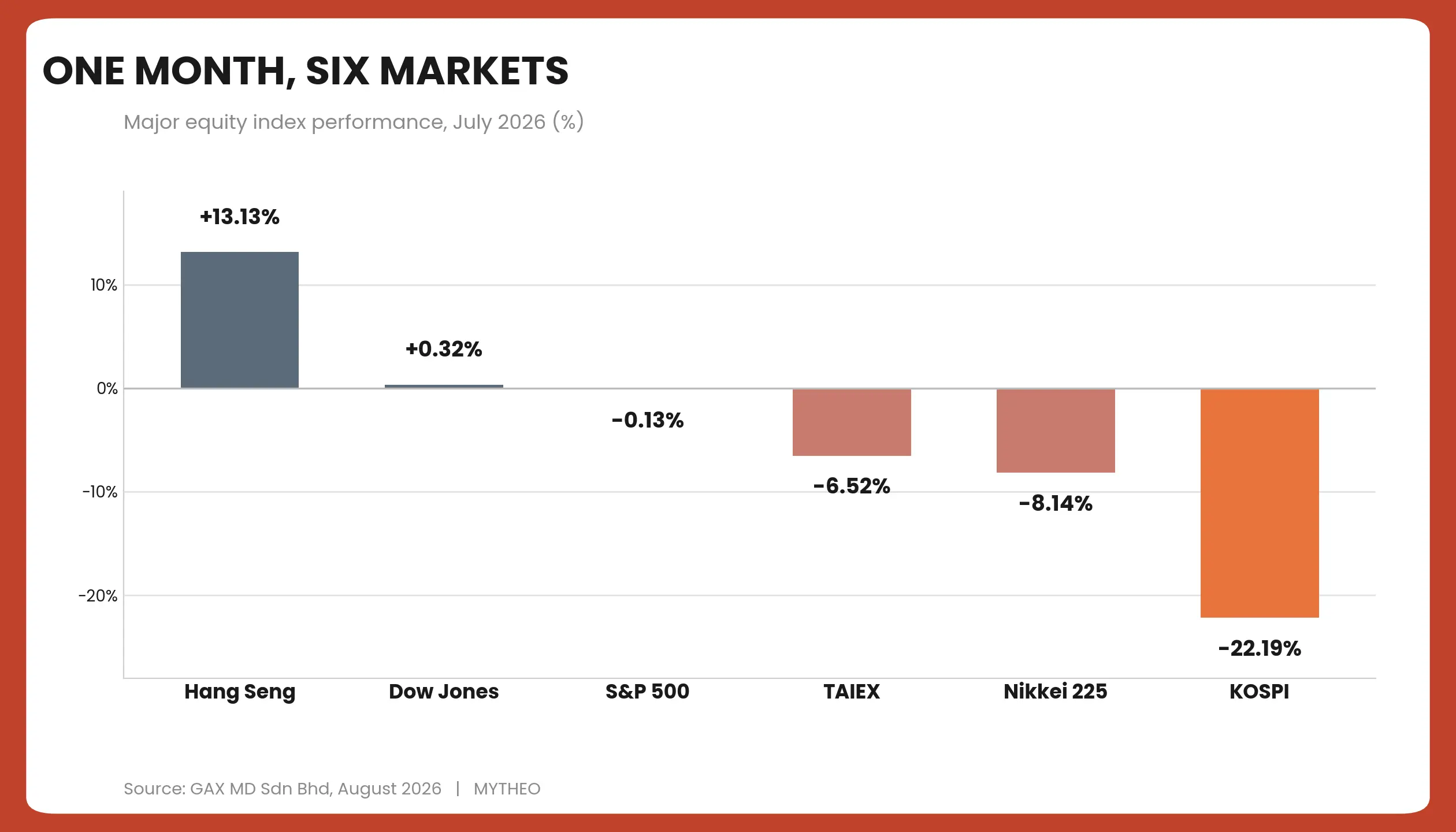
Global equities were far from uniform in July. In the United States, the S&P 500 ended almost flat at -0.13%, while the Dow Jones Industrial Average gained 0.32%. The muted headline performance masked an active rotation beneath the surface. Investors moved away from high-multiple technology names early in the month and toward industrial and energy-linked companies that benefited from higher crude oil prices and renewed concerns over supply disruption.
Asia-Pacific markets showed even sharper dispersion. Hong Kong’s Hang Seng Index surged 13.13%, as investors attracted to its relatively cheap valuations. In contrast, North Asian technology hubs endured severe drawdowns. Japan’s Nikkei 225 fell 8.14%, South Korea’s KOSPI dropped 22.19%, and Taiwan’s TAIEX retreated 6.52%. Margin calls, systematic de-risking and growing caution around semiconductor capital spending amplified the pressure across hardware supply chains.
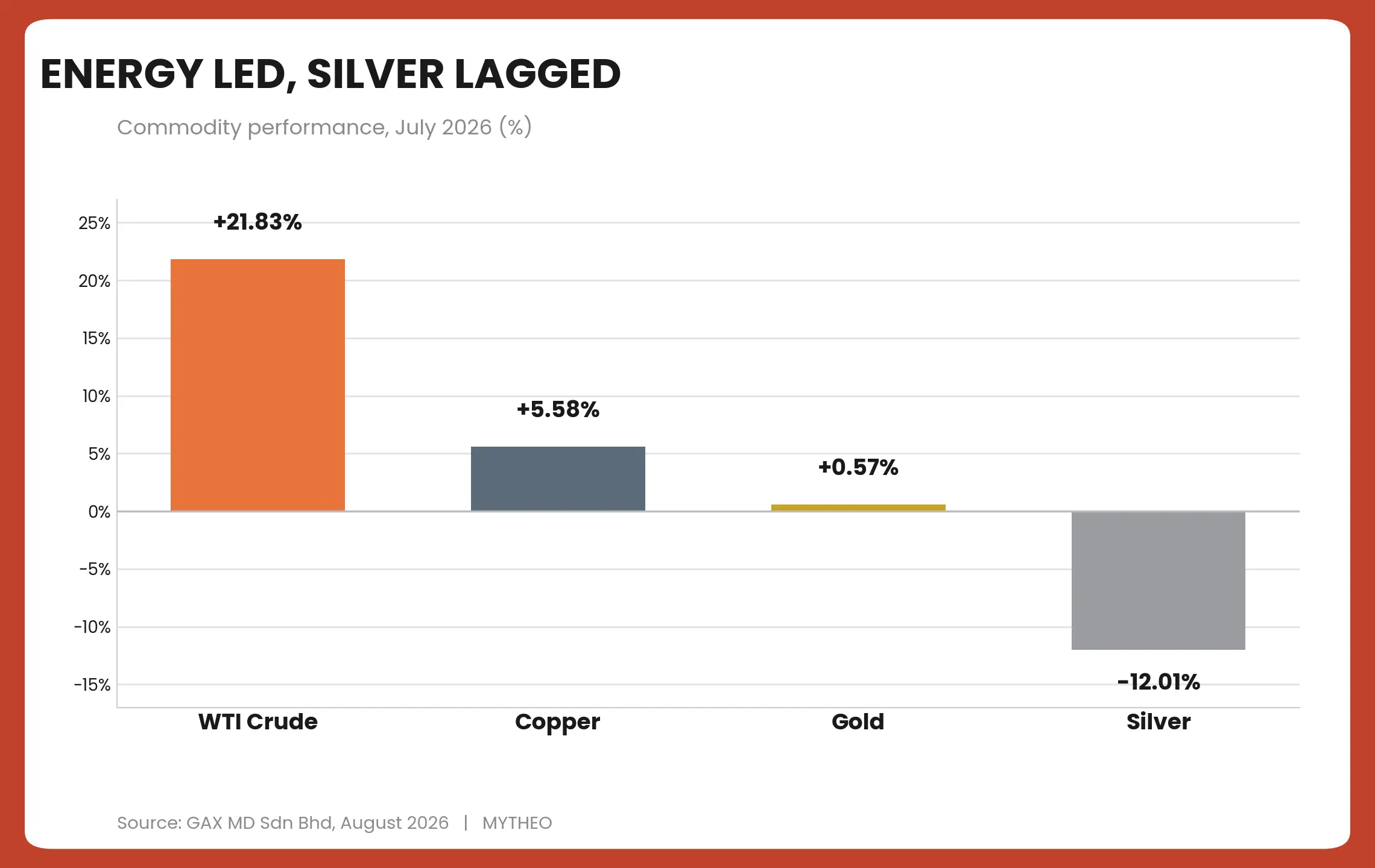
Commodity markets were dominated by energy. WTI crude rose 21.83% in July to close at $84.67 per barrel as shipping disruption through the Strait of Hormuz lifted the geopolitical risk premium. Industrial metals also strengthened, with copper gaining 5.58% on resilient demand from grid expansion and AI infrastructure. Precious metals diverged: gold held firm at 0.57% to $4,038 per ounce as safe-haven demand offset yield pressure, while silver fell 12.01% to $57.27 per ounce.
Bond markets repriced as investors reassessed the inflation outlook against the backdrop of higher energy prices. The US 10-year Treasury yield rose by 33 basis points in July to close at 4.75%. At the Federal Reserve’s 28–29 July meeting, policymakers kept the target range unchanged at 3.50%–3.75% for a fourth consecutive meeting, but the statement carried a distinctly hawkish tone. Three officials dissented in favour of a 25-basis-point increase, citing persistent inflation risks.
Market expectations shifted rapidly following the meeting. While investors initially viewed the Fed's hawkish tone as increasing the likelihood of further tightening, subsequent inflation data prompted a reassessment. US inflation eased to 3.40% in July, down from 4.20% in May and 3.50% in June, suggesting that price pressures continued to moderate despite higher energy prices. As a result, expectations for an additional rate increase softened, with market-implied odds of a September hike falling to around 25%.
Oil Market: Geopolitical Headlines Keep Volatility Elevated
*Source: GAX MD Sdn Bhd, August 2026
Geopolitical risk remained a key influence on energy markets throughout July. Uncertainty surrounding the Trump administration's stance on the Iran conflict, coupled with concerns over potential disruption in the Strait of Hormuz, kept a risk premium embedded in crude oil prices. When the ceasefire collapsed on 8 July and tensions escalated again, oil prices reacted immediately. The response reflected investors' concern that any threat to one of the world's most important shipping routes could disrupt global supply and tighten oil markets.
By month-end, however, both sides had halted attacks after nearly two weeks of intensifying US airstrikes and resumed talks. Oil prices responded sharply to each shift in the news flow, highlighting how quickly sentiment can turn when geopolitical progress changes. For investors, the key takeaway is that energy volatility is likely to remain headline-driven and difficult to forecast, making disciplined risk management more important than short-term directional calls.
Technology: From AI Capex Fear Sell-off to Earnings-Led Rally
The technology sector continued to follow a familiar pattern seen in recent months. In July, technology shares began the month under pressure as investors questioned whether the scale of AI and data-centre capital expenditure would dilute returns, compress margins, and leave even the strongest companies vulnerable to overinvestment.
Late-month earnings reports, however, shifted market sentiment. Microsoft surged 15.51% on July 30th, marking the largest single-day increase in market value in its history after delivering stronger-than-expected cloud results. Amazon followed with a 15.32% gain on July 31st, as AWS revenue grew 37%, its fastest pace of growth in eighteen quarters. For the month of July, Microsoft finished 24.58% higher, more than recovering its 17.15% decline in June. Similarly, Amazon ended the month with a 13.95% gain, fully offsetting its 11.93% loss in the previous month.
The rally in Microsoft and Amazon underscores a pattern investors now know well: concerns over AI-related spending can weigh on sentiment, but strong earnings can flip that sentiment just as fast. For now, technology investors face a three-way balancing act between valuations, capital expenditure and earnings growth, making the sector far less straightforward than it was just a few years ago.
Korean Market: Why “FOMO” hits you back
When emotion enters investment decision-making, risk can escalate quickly. South Korea’s market offered a clear example of how fear of missing out, leverage and crowded positioning can turn a strong rally into a sharp reversal. The Korean market had been among the world’s best-performing markets year to date, arguably the strongest. However, it fell 22.19% in July, one of the harshest monthly declines among major equity benchmarks. Earlier optimism around technology exposure encouraged aggressive participation, including margin trading by retail investors seeking to capture the rally. When sentiment reversed, forced selling intensified the decline and turned a correction into a market stress event.
Reports indicated that retail investors recorded a KRW8.284 trillion net sell-off, equivalent to US$5.85 billion, on 31 July in South Korea’s main KOSPI market. This marked a record single-day net sell-off by individual investors. The selling occurred as the index rebounded after a historic market crash driven by the collapse of leveraged AI semiconductor bets. Repeated trading halts and circuit-breaker activations during the month showed how quickly liquidity can disappear when risk controls are overwhelmed. An estimated 1.2 million South Koreans (about 3.4% of the adult population or roughly 1 in every 30 adults) received margin calls during the sharp market sell-off. Of those, between 320,000 and 360,000 accounts were forcibly liquidated by brokers, heavily impacting young workers and first-time investors.
Conclusion
- Do Not Overreact to Headlines.
Markets frequently overreact to breaking geopolitical events, yet long term economic outcomes are rarely as extreme as initial headlines suggest. While the Iran conflict initially triggered an aggressive oil rally, prices stabilized once diplomatic negotiations resumed. Global markets and supply chains consistently adapt to regional shocks over time, making a focus on economic fundamentals superior to trading headline noise. We saw a similar pattern during the Russia-Ukraine war when it first broke out in 2022. The conflict initially had a significant negative impact on global markets and supply chains. However, despite the war continuing today, its influence on market performance has diminished substantially as companies, consumers, and global supply chains adapted to the new environment. - Technology stocks continue to face intense scrutiny.
Investing across technology and AI is becoming more nuanced than it was during the early phase of the cycle. With hyperscalers projected to deploy nearly US$700 billion in infrastructure spending in 2026, the pace of capital expenditure growth will eventually need to normalize. Markets are already beginning to distinguish between pure-play hardware suppliers, such as TSMC, ASML, Nvidia and memory producers, whose earnings remain tied to cyclical equipment demand, and enterprise platform leaders, such as Microsoft, Alphabet, Amazon, Anthropic and OpenAI, that are better positioned to capture recurring software revenue from deployed AI models.
In recent years, most AI-related stocks moved largely in the same direction as investors broadly rewarded anything associated with the AI theme. Going forward, that relationship may become less predictable. Pure hardware players may struggle to sustain their previous pace of growth, while platform leaders may deliver more resilient earnings. As a result, we could see wider divergence in share-price performance across technology companies. In this environment, diversification may prove more important than ever. - Avoid Leverage and Chasing Momentum.
The severe drawdown in South Korea underscores the destructive potential of margin debt and crowded thematic trading. While leverage amplifies gains during bull markets, it accelerates capital destruction during sudden liquidity squeezes. At MYTHEO, we avoid concentrated single asset bets and do not invest in leveraged ETFs. Maintaining broad diversification across asset classes and geographies remains the most reliable strategy for preserving and compounding wealth.
Ready to explore how MYTHEO works for your goals? Learn more here.
Or download our app so you can start investing in a moment. Download on iOS here or Android here.
To register for MYTHEO, you can get started here.
This material is subject to MYTHEO’s Notice and Disclaimer.