

Key Takeaways
- September's selloff was not driven by recession fears or deteriorating earnings, but by a bond market repricing that caught investors off guard.
- As investors focus on bond yields today and US midterm elections tomorrow, the biggest market opportunities may emerge when expectations become overly pessimistic.
- History suggests market corrections feel uncomfortable in the moment, but they have often been temporary detours rather than permanent changes in market direction.
Market Review
September was broadly a difficult month for investors, with equities, bonds and most commodities ending lower as rising global bond yields once again became the dominant market theme.
While macroeconomic and geopolitical developments were relatively limited during the month, investors grew increasingly concerned about the sharp rise in sovereign bond yields. The US 10-year Treasury yield broke decisively above the psychologically important 5% level and closed the month at 5.29%, a move that intensified pressure across global financial markets. Higher yields increase borrowing costs and make bonds more attractive to investors relative to other asset classes, creating headwinds for equities and other risk assets simultaneously.
Performance of Selected Markets Monitored by MYTHEO, September 2026
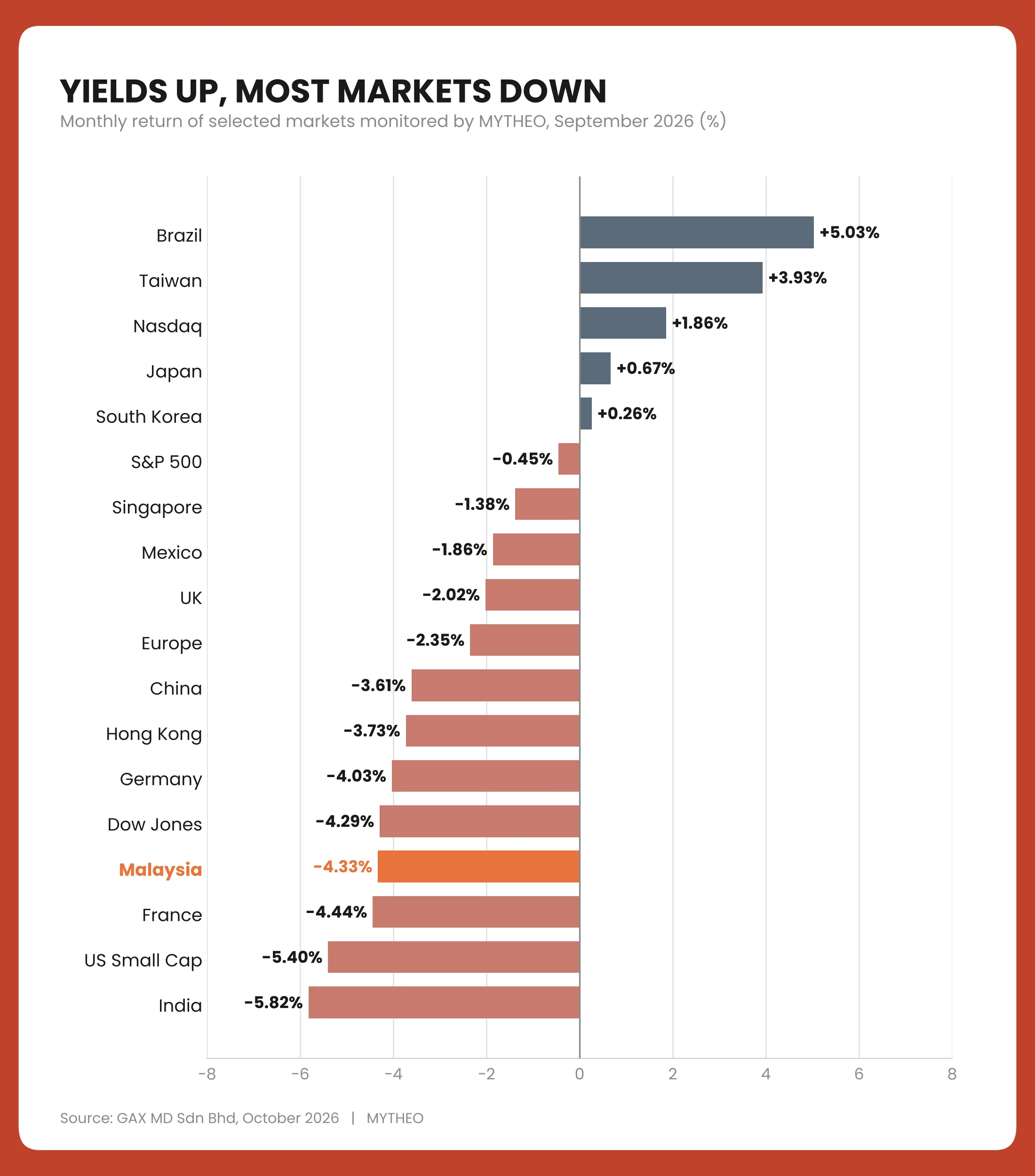
US equity performance illustrated this dynamic through clear dispersion. The industrial-heavy Dow Jones Industrial Average dropped 4.29%, ending a five-month winning streak as capital-intensive manufacturing, infrastructure and banking constituents absorbed higher borrowing cost projections. The S&P 500 was more resilient, dipping just 0.45%.
In contrast, the tech-weighted Nasdaq Composite appreciated 1.86%. This advance was not a broad market rally, but was driven by select mega-cap companies making headlines. Meta Platforms surged 26.80% following the rollout of Meta Muse AI, while Advanced Micro Devices (AMD) advanced 29.96% after agreeing to acquire World Labs for US$8.2 billion in an all-stock transaction.
Outside the US, positive market performance was scarce. One notable exception was Brazil. The Brazilian market benefited from the country's fifth consecutive interest rate cut, making it one of the few major economies easing monetary policy while much of the developed world continues to tighten financial conditions. Investor sentiment was further supported by government projections for a record trade surplus exceeding US$90 billion.
Elsewhere, the strongest performing markets were those with significant exposure to artificial intelligence and semiconductor supply chains. Technology leadership helped Taiwan, Japan and South Korea remain among the few markets delivering positive returns during the month.
Central Banks Synchronize Tightening
A major contributor to September's market weakness was the resurgence of concerns that global interest rates may remain higher for longer than investors had previously anticipated.
Those concerns intensified after a series of policy decisions from major central banks during the month. The European Central Bank (ECB) began the sequence by raising its key policy rates by 25 basis points, citing persistent inflationary pressures, particularly in the energy sector. The US Federal Reserve followed with its first rate hike since July 2023, lifting the federal funds rate target range to 3.75% to 4.00%. Days later, the Bank of Japan also tightened monetary policy, raising its policy rate to 1.25%, the highest level in more than three decades.
While the individual decisions reflected different domestic economic challenges, together they delivered a clear message to investors: major central banks were not yet prepared to declare victory over inflation. Expectations for an imminent shift towards monetary easing were pushed further out, prompting a sharp rise in global sovereign bond yields and reducing investors' appetite for risk assets. As borrowing costs moved higher and liquidity expectations tightened, equity markets came under pressure across most major regions.
Bond Market Becomes the Main Story
Although investors often focus on equity markets, the bond market was arguably the most important driver of asset prices in September. The rise in US Treasury yields created a challenging backdrop for nearly all asset classes. Higher yields increased the relative attractiveness of government bonds while simultaneously raising financing costs across the economy. As a result, equity valuations came under pressure as investors adjusted to a higher-for-longer interest rate environment.
In our view, much of the valuation adjustment has already occurred. At current levels, a 10-year Treasury yield of around 5.3% offers meaningful compensation relative to prevailing inflation expectations. However, a sustained bond rally may remain difficult until one of two conditions emerges: a meaningful decline in energy prices or clearer evidence of a material slowdown in labour markets.
US Dollar Strength Reflects Defensive Positioning
The surge in bond yields quickly spilled over into currency markets. As Treasury yields moved higher and risk appetite weakened, investors increasingly favoured US assets. This defensive positioning helped lift the US Dollar Index by 2.15% during the month, strengthening against most major and emerging market currencies. Against the Malaysian ringgit, the US dollar appreciated 1.42%.
A stronger dollar is a common feature of periods characterised by rising US yields and elevated risk aversion, reflecting both the relative safety and yield advantage offered by US financial assets.
Commodities Deliver Mixed Results
The stronger US dollar and deteriorating risk sentiment created a difficult backdrop for commodity markets, although performance varied significantly across sectors.
Crude oil was the notable exception. West Texas Intermediate (WTI) crude rose 4.23% to close at US$89.05 per barrel, supported by ongoing geopolitical tensions in the Middle East and concerns over potential disruptions to global energy supply routes.
Most other commodity segments struggled during the month as higher interest rates, a stronger US dollar, and cautious investor positioning weighed on demand expectations and broader market sentiment.
Market Corrections Are More Common Than Most Investors Think
The sharp rise in bond yields triggered a broad market correction during September, unsettling investors across both equity and fixed income markets. While periods of heightened volatility often feel uncomfortable, they are far from unusual.
Over the past three years, the S&P 500 has experienced six separate corrections of more than 5%, equivalent to roughly two meaningful pullbacks each year. Importantly, none of these episodes marked the end of the broader market cycle. In every case, markets eventually recovered as investors refocused on economic fundamentals and corporate earnings.
The current environment bears some resemblance to the correction between July and October 2023, when the S&P 500 declined 10.28% as rising Treasury yields and "higher-for-longer" rate expectations pressured valuations across risk assets. Sentiment deteriorated sharply at the time, yet markets ultimately recovered once investors became more comfortable with the interest rate outlook.
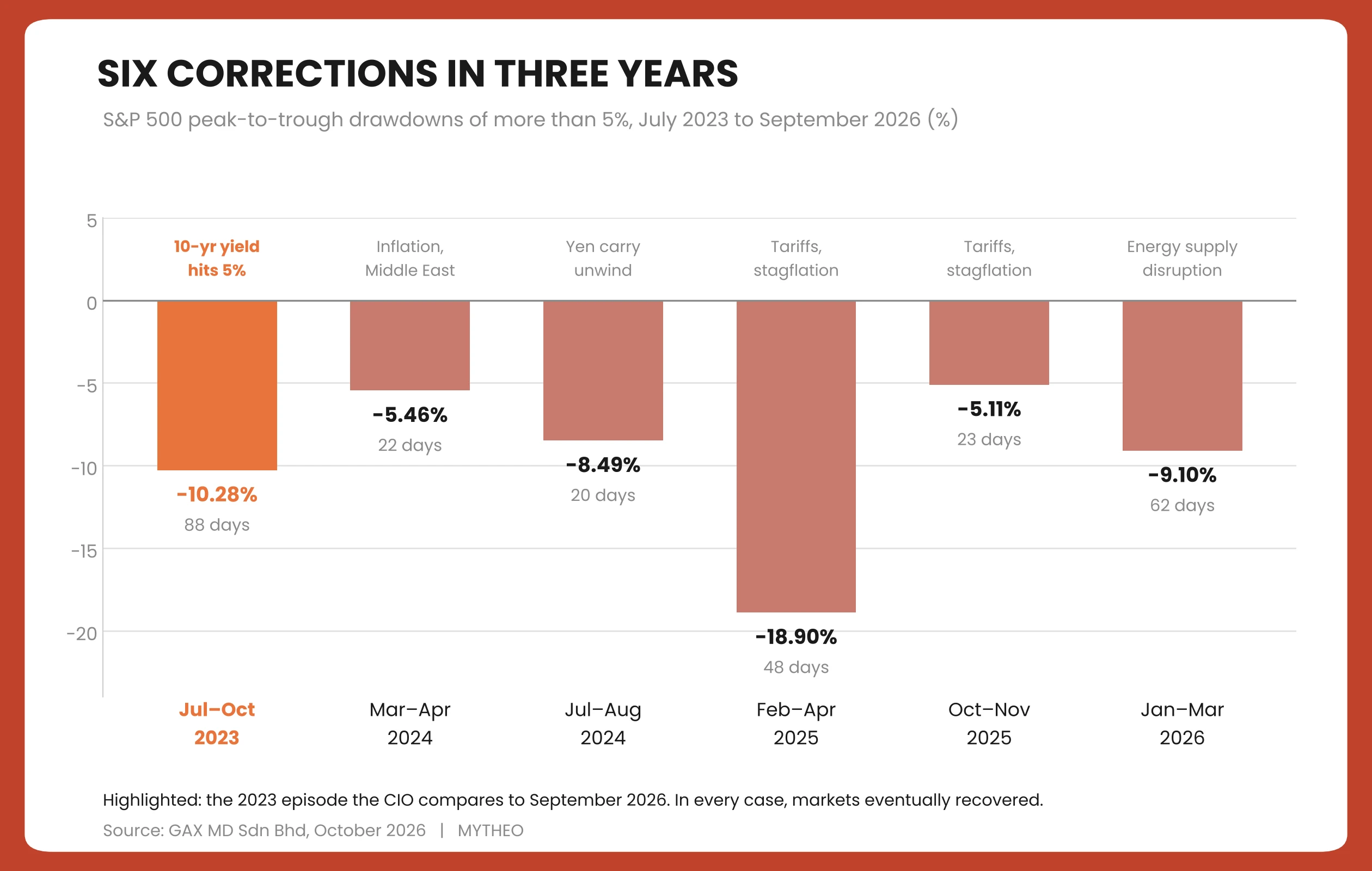
The lesson is not that corrections should be ignored, but that they should be viewed in context. Markets often struggle when investors are forced to reassess expectations, whether around interest rates, inflation or economic growth. Once those expectations stabilise, uncertainty tends to fade even if the fundamental backdrop has not changed dramatically.
Rather than viewing corrections purely as a source of concern, long-term investors should also recognise the opportunities they create. Periods of temporary market weakness often allow investors to accumulate quality assets at more attractive valuations and position themselves for the eventual recovery.
As September drew to a close, investors were already beginning to look beyond bond yields. The next potential market catalyst may not come from central banks, but from Washington. With the US midterm elections approaching in November, attention is gradually shifting from monetary policy to politics and the potential implications for fiscal policy, regulation and investor sentiment.
Although the presidency is not at stake, the election will determine control of both the House of Representatives and the Senate. The outcome carries important implications for fiscal policy, industrial spending, clean energy initiatives and the broader legislative agenda over the remainder of President Donald Trump's term.
We discussed the mid-term election impact in our other article: Is the US Mid-term Election the Next Market Catalyst?
Conclusion: Volatility Creates Opportunity for Disciplined Investors
Looking back, September was less about deteriorating fundamentals and more about investors attempting to price future uncertainties all at once. The market is currently navigating two important questions. The first is whether bond yields have risen far enough to compensate investors for inflation and economic risks. The second is whether the upcoming US mid-term elections could alter the political landscape and reshape policy priorities over the next two years.
The challenge is that neither question has a definitive answer today. Yet financial markets rarely wait for certainty. Investors continuously adjust expectations based on incomplete information, often resulting in periods of heightened volatility and market corrections.
History shows that such environments rarely end when uncertainty disappears. Rather, they end when investors become comfortable enough with the range of possible outcomes. The same was true during the 2023 correction, when concerns over rising yields dominated market sentiment before eventually giving way to recovery once expectations stabilised.
For investors, the more important observation is that corrections and political events often create significantly more headlines than they create lasting changes to long-term market direction. Elections determine who governs, while bond markets determine the cost of capital, but ultimately both become just another chapter in a much longer investment journey.
As markets continue debating these uncertainties, we believe investors should focus less on predicting the next headline and more on identifying opportunities created by temporary dislocations. Periods when uncertainty is highest are often the very moments when future opportunities begin to emerge.
Ready to explore how MYTHEO works for your goals? Learn more here.
Or download our app so you can start investing in a moment. Download on iOS here or Android here.
To register for MYTHEO, you can get started here.
This material is subject to MYTHEO’s Notice and Disclaimer.