

Key Takeaways
- Headlines focused on US Treasury yields, but Malaysia's 10-year government bond yield rose more than 13 times as much as the US equivalent during August.
- Rising yields do not necessarily mean losing money in bonds. Income, carry and spread income often matter more than short-term price fluctuations.
- The portfolio's diversified structure helped cushion the impact of the global bond sell-off. MYTHEO Income remained positive because returns were sourced from multiple fixed-income sectors rather than government bonds alone.
- Today's higher yields are tomorrow's higher returns. Investors entering the bond market today are being compensated with meaningfully better income than they were just a few months ago.
Throughout August 2026, rising US Treasury yields dominated the financial news cycle. Concerns over escalating borrowing costs sparked intense commentary from policymakers and widespread media attention.
For Malaysian investors, the development naturally raised questions about the implications for fixed-income portfolios with US exposure. US fixed income represents more than 70% of the MYTHEO Income portfolio, leading some investors to wonder whether rising Treasury yields would negatively affect portfolio performance.
However, the market narrative focused on the wrong issue. The rise in bond yields was not unique to the US. It was part of a broader global repricing of sovereign debt markets. While headlines focused on US Treasuries, government bond yields increased across most major economies during the month. The real story was global repricing.
Yield Comparison: 10-Year Treasuries Across Major Markets
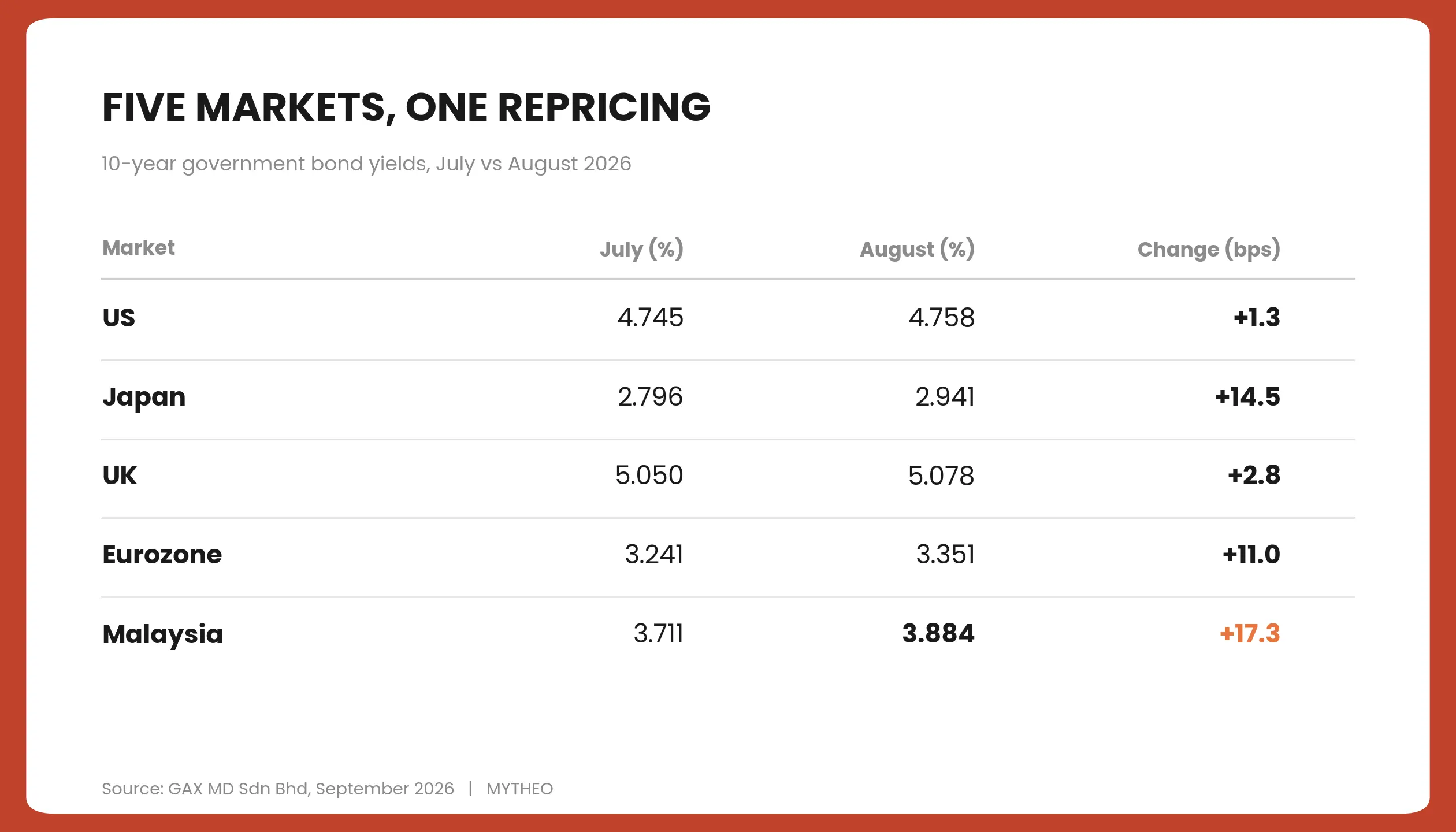
As the table illustrates, the 10-year US Treasury yield ended August at 4.758%, just 1.3 basis points higher than the previous month. By comparison, Malaysian government bond yields rose 17.3 basis points, Japanese government bond yields increased 14.5 basis points, and Eurozone sovereign bond yields climbed 11.0 basis points.
The evidence suggests investors were responding to a broader global shift rather than a uniquely the US concern. Bond markets globally were repricing to reflect similar concerns, including larger government borrowing requirements, persistent fiscal deficits, rising debt burdens and the possibility that neutral interest rates may remain structurally higher than previously expected.
Why Malaysian Bond Investors Were More Exposed
At the end of August, Malaysian government bonds yielded 3.884%, while the US Treasury yielded 4.758%. Lower-yielding bonds are typically more sensitive to rising yields than higher-yielding bonds with similar duration characteristics. This meant Malaysian bond investors faced a double challenge.
First, Malaysian bond yields are generally lower than comparable US Treasury yields across similar maturities. Second, Malaysian yields increased substantially more than US yields during the month. As a result, Investors concentrated solely in domestic Malaysian fixed income naturally experienced a much rougher ride than those with diversified, global exposure.
Why MYTHEO Income Remained Resilient
Understanding that the sell-off was global is only half the story. The more pressing question is: Why did the MYTHEO Income portfolio remain positive despite rising yields?
The answer lies in diversification. Many retail investors mistakenly equate "fixed income" solely with government bonds. In reality, the global bond market is vast, and different sectors react differently to macroeconomic shifts.
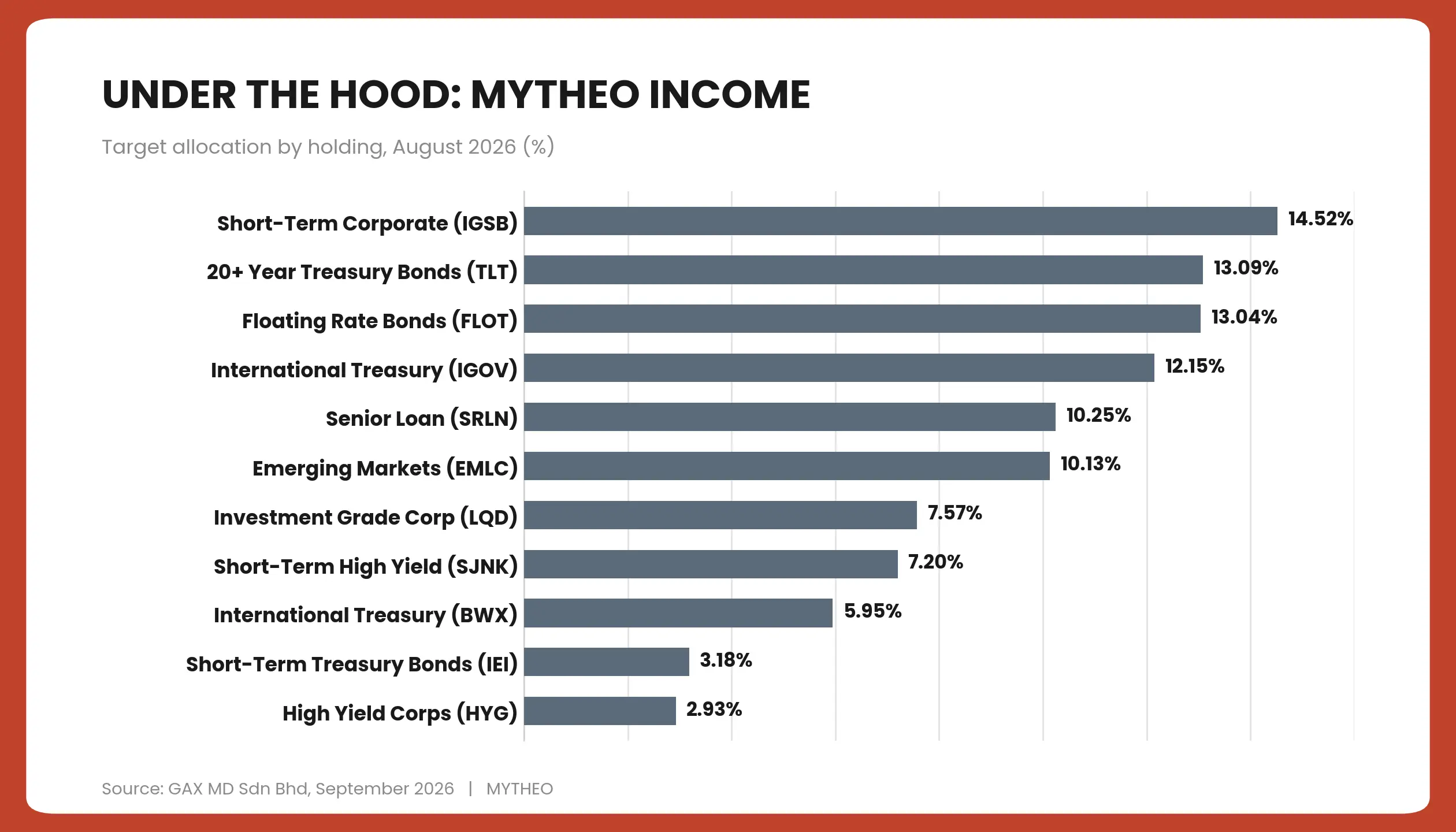
Rather than relying purely on sovereign debt, MYTHEO Income maintains strategic exposure across treasury bonds, investment-grade corporates, high-yield bonds, floating-rate securities, senior secured loans, and international fixed-income markets. By spreading risk across these varied income drivers, the portfolio successfully offset the drag of rising government bond yields.
Under the Hood: MYTHEO Income Portfolio Allocation
Higher Yields Are Not Necessarily Bad News
One of the most misunderstood aspects of bond investing is the relationship between yields and long-term returns. While rising yields typically create short term price volatility, investors should remember that bond yields are also one of the strongest indicators of future bond returns.
For example, an investor purchasing a US 10-year Treasury yielding 5.03% on 14 September 2026 can reasonably expect to earn approximately 5.03% annually if the bond is held to maturity, assuming the US government meets its obligations.
Importantly, that yield is roughly 50 basis points higher than it was only three months earlier.
Viewed from this perspective, higher bond yields should not be seen solely as a risk. They also represent an opportunity, as investors are being compensated with higher future income and improved expected returns.
When Bonds Become the Competition: Ripple Effects on Other Assets
So far, the impact of higher bond yields has been largely contained within the fixed-income market. Equities have remained resilient, and commodities and real assets continue to be supported by solid underlying fundamentals.
However, investors should not assume this will always be the case.
If bond yields continue to climb, the effects will inevitably bleed into other asset classes. Higher government bond yields make fixed income highly competitive against equities, property, and other risk assets. When investors can suddenly earn attractive, low risk returns in the bond market, the incentive to take on extra risk elsewhere diminishes.
Capital may gradually rotate out of risk assets and back into fixed income. This rotation can increase market volatility and place downward pressure on the valuations of equities and real estate.
This is also where bonds begin to regain their traditional role within diversified portfolios. While rising yields can create short-term price volatility, they also improve future income potential and strengthen the defensive characteristics of fixed income.
This is one of the reasons why pension funds, insurance companies and sovereign wealth funds continue to maintain substantial allocations to bonds regardless of market conditions. When yields become sufficiently attractive, bonds once again serve as both an income-generating asset and a source of portfolio stability.
Conclusion
While investors focused on rising US Treasury yields, the reality was a broad global repricing of sovereign bond markets. In fact, Malaysian government bond yields rose significantly more than their US counterparts during the month.
More importantly, rising yields do not automatically translate into poor bond returns. Diversified fixed-income portfolios draw returns from a broader range of sources than government bonds alone. corporate credit, high-yield bonds, floating-rate securities and international fixed-income markets can all contribute to portfolio income and performance during different market environments. The MYTHEO Income portfolio’s performance is a testament to how diversified income sources can mitigate the impact of rising sovereign yields.
For long-term investors, the recent adjustment may ultimately prove constructive. Higher yields improve future return expectations, enhance portfolio income potential and restore some of the defensive characteristics that fixed income had lost during years of exceptionally low rates. Investors today are able to lock in more attractive income levels than they could just a few months ago, strengthening the long-term investment case for fixed income.
This is why bonds, particularly high-quality government bonds and diversified fixed income portfolios, remain a strategic allocation for large institutional investors across all market environments.
For MYTHEO Income investors, exposure to multiple fixed income sectors, global bond markets and a wide range of income drivers continues to provide a strong foundation for generating sustainable income while managing risk over the long term.
Ready to explore how MYTHEO works for your goals? Learn more here.
Or download our app so you can start investing in a moment. Download on iOS here or Android here.
To register for MYTHEO, you can get started here.
This material is subject to MYTHEO’s Notice and Disclaimer.